
MotiveMesh is a modular storage and mounting system for 3D printers, started by Mint Motive. It is open and in the public domain: the specification, the design brief, the design guidelines, the reference models and drawings, and the MotiveMorph generator that builds the parts are all released under CC0 1.0. No rights are reserved. You may use, copy, change, print, sell and build on any of it, with or without credit, for any purpose.
Specification version: 1.0 (draft). See what "draft" means.
What MotiveMesh is made of
| Part | What it does | Where it is specified |
|---|---|---|
| The grid | Every part sits on a 30 mm node grid. | Specification §2 |
| Tiles | Lattice wall and desk panels, 5 mm thick on a 6 mm standoff, with a twist-lock socket at every node. They join with connector keys and screw down at the corners. | Specification §4 |
| Twist-lock sockets and pins | A round hole with two lug slots. A pin goes through an accessory and a tile, turns a quarter turn, and its lugs lock behind the tile. | Specification §3 |
| Connector keys | Dovetail keys that join two tiles at a seam. | Specification §5 |
| Magnets | Optional 6 × 2 mm magnets, hidden in blind pockets, for parts that should lift off. | Specification §6 |
| Accessories | Bins, shelves, hooks and tool trays with a back plate that mounts on the grid. | Specification §7 |
| The Desk Pod | A freestanding desk unit with a leaning front, built in parts that print without supports, that links side by side. | Specification §8 |
| Material-aware building | Parts are built for the filament they are printed in: strong filaments get an open lattice skeleton. | Specification §9 |
| Auras | Three looks for three places: the Paddock, the Studio and the Galley. | Design guidelines |
| MotiveMorph | The free generator that builds every part to this specification. | vertex.mintmotive.com.au/morph and public/js/geometry/morph.js |
The documents
- Design brief: why MotiveMesh exists, who it is for, the principles it follows and what it deliberately is not.
- Specification: every dimension and tolerance you need to make a compatible part.
- Design guidelines: the Auras, colours, type, lattice rules, printability rules and how to name and present parts.
- Contributing: how to make compatible parts, propose a change to the standard, and how versions work.
- Reference files: drawings and printable models generated from the engine, so they always match the specification.
Reference files
| File | What it is |
|---|---|
| socket.svg | Twist-lock socket, dimensioned |
| twist-lock-pin.svg and twist-lock-pin.stl | The pin, drawing and model |
| connector-key.svg and connector-key.stl | The connector key and the notch it fits |
| tile-2x2.svg and tile-2x2.stl | A 2 × 2 tile |
| fit-test-tile-1x1.stl | A one-node tile: print it with a pin first to check your printer's fit |
| desk-pod-profiles.svg | Desk Pod side profiles for each Aura |
| desk-pod-studio.3mf | A complete Studio Desk Pod, every part, ready to slice |
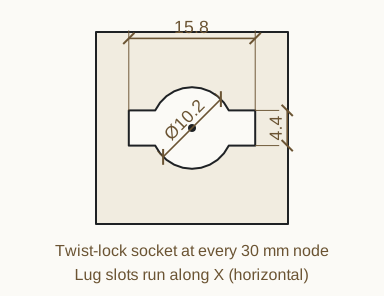
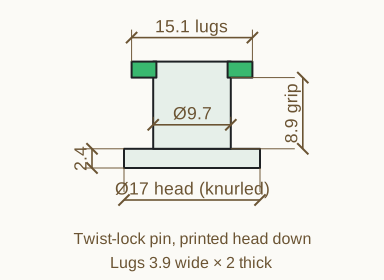
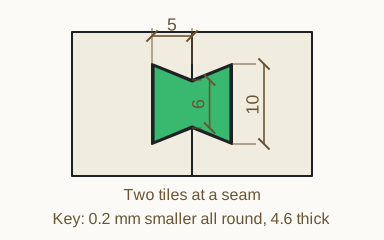
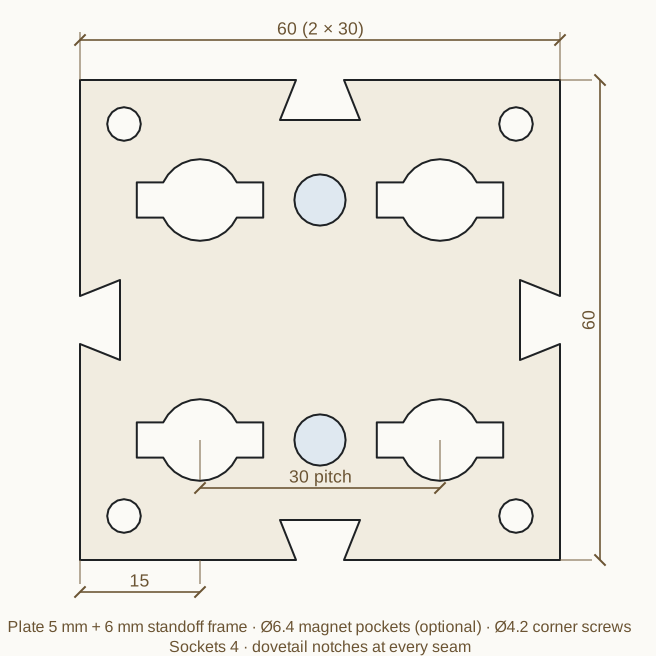
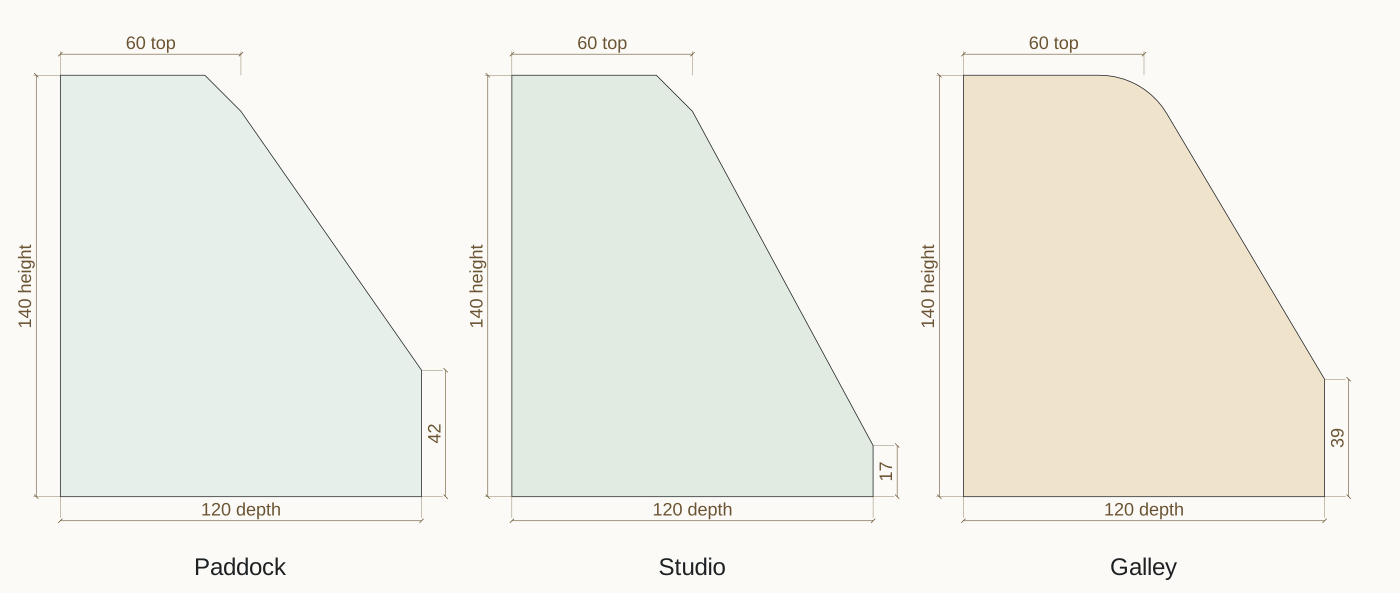
Regenerate them after changing the engine with node scripts/motivemesh-reference.mjs.
Quick start
- Print the fit test tile and a pin. The pin should pass through with a light push, turn a quarter turn and hold without rattling. Adjust the clearance in MotiveMorph if it does not.
- Make tiles in MotiveMorph and join them with connector keys. Screw the corners to the wall or desk.
- Add accessories, or make your own to the specification in any CAD program.
- Share what you make on VERTEX. Everything shared there is CC0 too.
Relationship to other systems
MotiveMesh is its own system. It is not Gridfinity and it is not IKEA SKÅDIS, and it does not try to fit either. The 30 mm grid and the twist-lock socket were chosen for wall and desk mounting, not for drawers. Gridfinity (created by Zack Freedman) and SKÅDIS accessories have their own generators on this site. SKÅDIS is a trademark of Inter IKEA Systems B.V.; MotiveMesh is not affiliated with IKEA.